
Popular Article
In-House Team, Agency or Freelancer? A 2026 Cost Comparison With Break-Even Hours
What an in-house hire really costs once benefits are included, how many hours of agency work that buys, and when an agency, an employee or a freelancer is the better choice.
The short answer
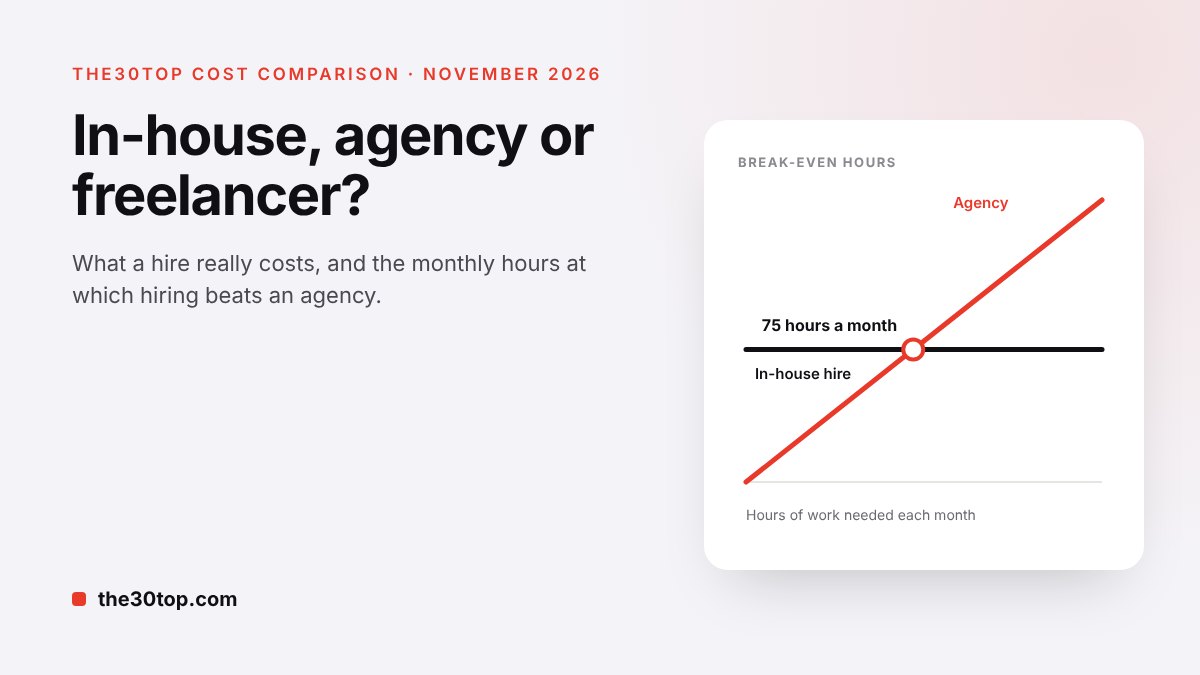
Hire in-house when you need one skill for most of the working week, every week. Use an agency when you need several skills, part-time, or quickly. Use a freelancer for well-defined work in a single skill that someone on your side can manage.
The numbers below make the trade-off concrete. They combine 2025 US pay data from the Bureau of Labor Statistics with the agency rates listed on the30top.
- a salary, the full cost of an employee once benefits are included
- 1.46×
- estimated yearly cost of a US marketing manager, salary plus benefits
- $243,500
- a month: the point where hiring a designer beats an agency at $150 an hour
- 51 hours
- median hourly rate listed by agencies on the30top
- $100 to $149
How the three options compare
| In-house hire | Agency | Freelancer | |
|---|---|---|---|
| How you pay | Salary plus benefits, every month | Retainer, project fee or hours | Hourly or per project |
| Time to start | Two to four months to recruit | Two to six weeks | Days to weeks |
| Range of skills | One person, one or two skills | A team with several skills | Usually one skill |
| Knowledge of your business | Deepest over time | Grows, but shared across clients | Limited to the task |
| Management needed | Highest: hiring, training, reviews | Moderate: briefs and approvals | High per task: you manage the work |
| If someone leaves | You start recruiting again | The agency replaces them | You find another freelancer |
| Best for | Core, continuous work | Multi-skill or specialist work | Defined tasks and overflow |
The real cost of an in-house hire
A salary is only part of what an employee costs. According to the Bureau of Labor Statistics, benefits such as insurance, paid leave and retirement made up 31.5% of the total cost of employing full-time private-industry workers in June 2026. That means total cost is about 1.46 times the salary, before recruiting fees, equipment, software and management time, which are not counted here.
The table applies that ratio to the median US salaries for common marketing, design and technology roles in May 2025, and divides the result by 1,800 productive hours a year to give an in-house cost per hour.
| Role | Median salary, May 2025 | Estimated cost with benefits | Cost per productive hour |
|---|---|---|---|
| Marketing manager | $166,790 | $243,500 | $135 |
| Software developer | $135,980 | $198,500 | $110 |
| Web and digital interface designer | $104,000 | $151,800 | $84 |
| Web developer | $92,650 | $135,300 | $75 |
| Market research analyst | $78,760 | $115,000 | $64 |
| Editor | $77,920 | $113,800 | $63 |
| Graphic designer | $62,960 | $91,900 | $51 |
Salaries are US Bureau of Labor Statistics medians for May 2025. Cost with benefits divides salary by 0.685, the wage share of total compensation for full-time private-industry workers in June 2026. Productive hours assume 1,800 a year after holidays and leave. Rounded to the nearest $100 and $1.
Break-even hours: when hiring beats an agency
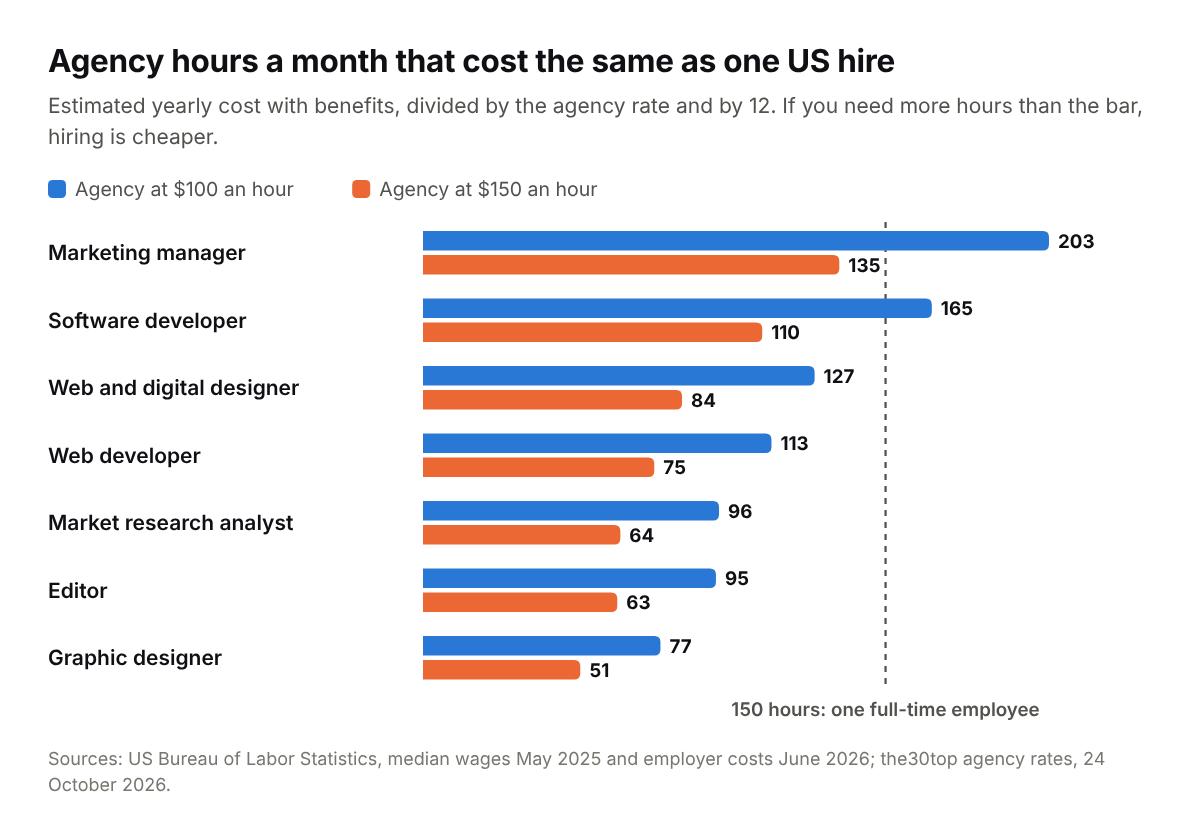
The fairest comparison is the number of agency hours a month you could buy for the cost of one employee. If you need more hours than that, hiring is cheaper; if you need fewer, the agency is. The chart shows the break-even point at two agency rates: $100 an hour, the bottom of the band where the median agency on the30top sits, and $150 an hour, the threshold that 29% of agencies list.
| Role | At $100 an hour | At $150 an hour |
|---|---|---|
| Marketing manager | 203 | 135 |
| Software developer | 165 | 110 |
| Web and digital interface designer | 127 | 84 |
| Web developer | 113 | 75 |
| Market research analyst | 96 | 64 |
| Editor | 95 | 63 |
| Graphic designer | 77 | 51 |
Estimated yearly cost with benefits divided by the agency rate and by 12. A full-time employee provides about 150 productive hours a month.
Read the table against the 150 productive hours a month a full-time employee provides. Where the break-even is above 150, as for a marketing manager at $100 an hour, an agency at that rate costs less even if you use it full time, because senior salaries are high relative to agency rates. Where it is well below 150, as for a graphic designer at 51 hours, hiring wins as soon as you need regular part-time work.
Two things the arithmetic leaves out push in opposite directions. An employee costs more than this once you add recruiting, tools and management. An agency costs more than its hourly rate once you add the time you spend briefing and reviewing its work. Our agency hourly rate data shows how widely rates vary by country, which moves these break-even points a long way.
A worked example: one web developer, three workloads
Suppose you need web development work and are weighing a US hire against an agency. The yearly cost of the employee stays the same whatever the workload, while the agency bill rises with every hour. The table shows how the answer flips as the workload grows.
| Hours needed a month | In-house web developer | Agency at $100 an hour | Agency at $150 an hour | Cheaper option |
|---|---|---|---|---|
| 40 | $135,300 | $48,000 | $72,000 | Agency at either rate |
| 75 | $135,300 | $90,000 | $135,000 | Agency at $100; even at $150 |
| 120 | $135,300 | $144,000 | $216,000 | In-house |
| 150 (full time) | $135,300 | $180,000 | $270,000 | In-house |
In-house cost is the estimated yearly cost with benefits for a US web developer from the table above. Agency cost is hours a month times the rate times 12.
At 40 hours a month the agency saves between $63,300 and $87,300 a year. At 120 hours, hiring saves between $8,700 and $80,700. Most of the decision comes down to an honest estimate of the hours, which is why a short trial with an agency or freelancer is often the best way to find out.
When the agency is in a lower-cost country
Agency rates vary by country far more than the break-even table suggests. On the30top, 89% of Indian providers and 48% of Ukrainian providers that list a rate charge under $50 an hour, against 16% of US providers.
At $50 an hour, the break-even point for a US web developer rises to about 226 hours a month, well above the 150 productive hours one employee provides. On cost alone, an agency at that rate is cheaper than a US hire at any workload. The trade-offs move elsewhere: overlap in working hours, written communication, the time you spend managing the work, and how much context the team has on your market.
The reverse also applies. If you are hiring outside the United States, local salaries may be far lower than the BLS figures used here, which lowers the break-even point. Redo the calculation with a local salary and the same 1.46 benefits multiplier as a first estimate, then check the local benefit costs.
The costs the hourly comparison leaves out
The break-even arithmetic compares salary and benefits with agency fees. Several real costs sit outside it, and they rarely cancel out.
| Option | Costs to add | When they matter most |
|---|---|---|
| In-house hire | Recruiting time or fees, equipment, software licences, training, management time, and the months before a new hire is fully productive | Specialist and senior roles that are slow to fill |
| Agency | Your time spent briefing, reviewing and approving, onboarding the agency, and handover when you switch | Work that needs deep product knowledge or fast internal decisions |
| Freelancer | Your time finding, briefing and coordinating, cover when the freelancer is unavailable, and quality checks | Several freelancers working on the same project |
When an agency is the better choice
Choose an agency when
- You need several skills, such as strategy, design, content and development, but none full time
- You need to start within weeks, not months
- The work needs senior specialists you could not attract or afford to employ
- Demand rises and falls, and you do not want to carry fixed salaries
Costs to watch
- Your time spent briefing, reviewing and approving work
- Knowledge that leaves with the agency when the contract ends
- Minimum terms and minimum budgets
- Senior people in the pitch, junior people on the work
If you go the agency route, our agency pricing models explainer covers how to structure the fee, and our 15 questions to ask an SEO agency shows how to test a shortlist before you sign.
When hiring in-house is the better choice
Hire when
- You need one skill for most of the working week, all year
- The work depends on deep knowledge of your product and customers
- Speed of internal decisions matters more than outside perspective
- You can offer a real career path for the role
Costs to watch
- Two to four months to recruit and more to get up to speed
- Benefits, equipment, software and management time
- A single point of failure when the person is away or leaves
- Skills that date if the person has no peers to learn from
When a freelancer is the better choice
Use a freelancer when
- The task is clearly defined and in a single skill
- Someone on your team can brief and review the work
- You need extra capacity for a few weeks or months
- Budget is tight and an agency's minimum is out of reach
Costs to watch
- No cover when the freelancer is ill or busy
- Your time spent coordinating several freelancers
- Limited strategy and quality control beyond the task
- Contracts that do not cover ownership or confidentiality
Hybrid models that often work best
Most growing companies end up with a mix. Four combinations come up again and again.
In-house lead, agency execution
One employee owns strategy and priorities; an agency supplies the specialist hours. Common in marketing teams of one to three people.
Agency builds, team runs
An agency delivers a website, app or brand, then hands it to in-house staff who maintain and improve it.
Freelancers under an in-house manager
A manager briefs and reviews a small bench of trusted freelancers for writing, design or development.
Fractional leadership
A part-time senior leader, such as a fractional marketing director, sets direction while agencies or freelancers do the work.
Questions to ask yourself first
- Will this work still exist, at the same volume, in a year?
- How many hours a month does it really need, and how sure am I of that number?
- Does it need one skill, or several that rarely add up to a full-time role each?
- Is anyone on my team able to brief and review the work?
- How quickly do I need results, and can I wait three months to recruit?
- What happens if the person or provider doing it disappears tomorrow?
- Is the knowledge behind this work something the company must own?
Decide in five steps
- 1
Step 1
Estimate the hours you need by skill
List the skills the work needs and how many hours a month each will take over the next year, not just the first quarter.
- 2
Step 2
Price each option
Use the cost with benefits for an in-house hire, quotes from two or three agencies, and freelancer rates for the same hours.
- 3
Step 3
Add management time
Estimate the hours your team will spend recruiting, briefing, reviewing and coordinating under each option, and cost them too.
- 4
Step 4
Weigh speed, continuity and risk
Decide how soon you need results and what happens if a key person leaves. These often settle a close call.
- 5
Step 5
Run a trial before you commit
A three-month agency or freelancer engagement shows how much work there really is before you hire for it.
Sources and assumptions
- Salaries: US Bureau of Labor Statistics, Occupational Outlook Handbook, median annual wages for May 2025.
- Benefits: US Bureau of Labor Statistics, Employer Costs for Employee Compensation, June 2026. Wages and salaries were 68.5% of total compensation for full-time private-industry workers.
- Agency rates: hourly rates listed on the30top company profiles, pulled 24 October 2026.
- Productive hours: an assumption of 1,800 hours a year after holidays, leave and internal time.
- Not included: recruiting fees, equipment, software, office space and management time for employees; briefing and review time for agencies and freelancers.
Frequently asked questions
Is it cheaper to hire an agency or an in-house employee?
It depends on how many hours you need. For a US web developer, hiring becomes cheaper than an agency at $150 an hour once you need more than about 75 hours a month. Below that, the agency usually costs less.
How much does an in-house marketing manager cost in the US?
The median salary for marketing managers was $166,790 in May 2025, according to the Bureau of Labor Statistics. With benefits, the total cost is roughly $243,500 a year, before recruiting and equipment.
What is the fully loaded cost of an employee?
Salary plus everything else the employer pays: insurance, paid leave, retirement contributions and payroll taxes. For full-time US private-industry workers in June 2026, benefits were 31.5% of total compensation, so total cost was about 1.46 times wages.
When should I use a freelancer instead of an agency?
When the task is well defined, needs a single skill and someone on your team can manage it. Choose an agency when you need several skills together, strategy as well as execution, or cover if someone is unavailable.
How many agency hours equal one full-time hire?
It ranges widely by role. At $150 an hour, the cost of a graphic designer equals about 51 agency hours a month, while a marketing manager equals about 135. At $100 an hour, a marketing manager costs as much as 203 agency hours a month.
Is an offshore agency cheaper than hiring in the US?
On cost alone, usually yes. At $50 an hour, an agency costs less than a US web developer even at full-time hours, because the break-even point is about 226 hours a month. The trade-offs are time zones, communication and the management time you add.
How many productive hours does a full-time employee work?
This comparison assumes about 1,800 a year, or 150 a month, after holidays, leave and internal time. Your own figure may differ, and a lower figure makes an in-house hire more expensive per hour.
Can I combine an in-house team with an agency?
Yes. An in-house lead who sets strategy and an agency that supplies specialist hours is one of the most common set-ups for small and mid-sized teams.
About the author
the30top Research Team (Research & analysis). We research service categories, interview buyers and maintain the30top rankings. Resource content is independent of listings and never paid for.
Related reading
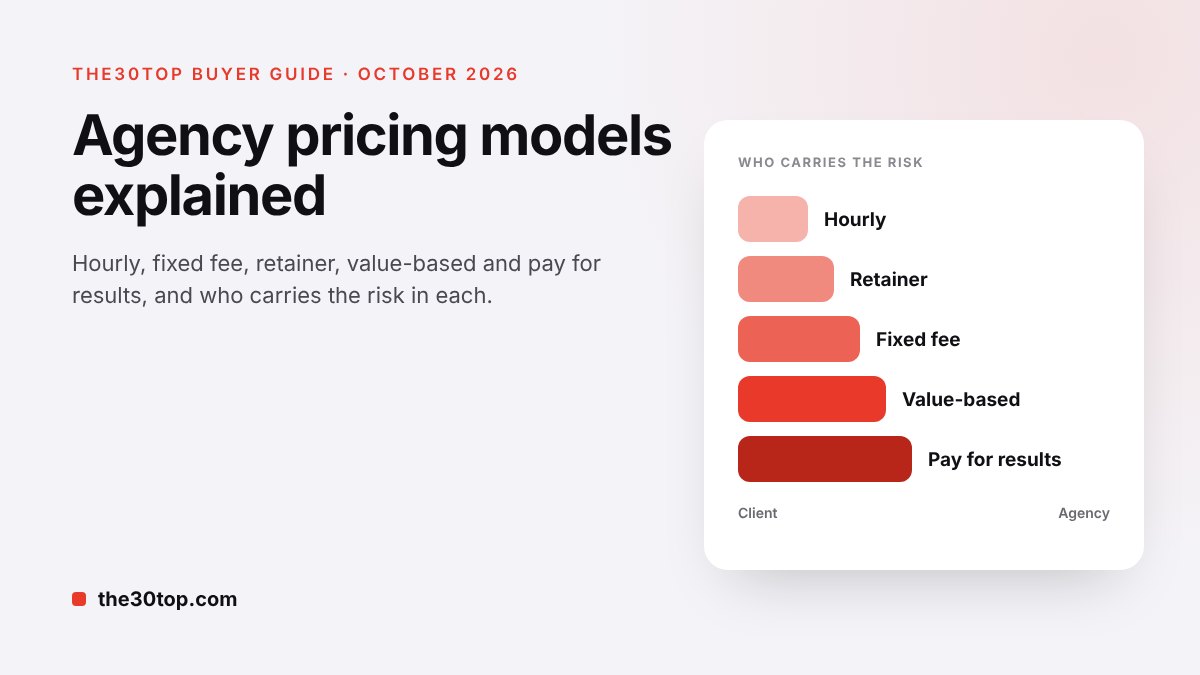
Agency Pricing Models Explained: Hourly, Fixed Fee, Retainer, Value-Based and Pay for Results
How each agency pricing model works, who carries the risk when work runs over, one project priced five different ways, and which model suits which kind of work.
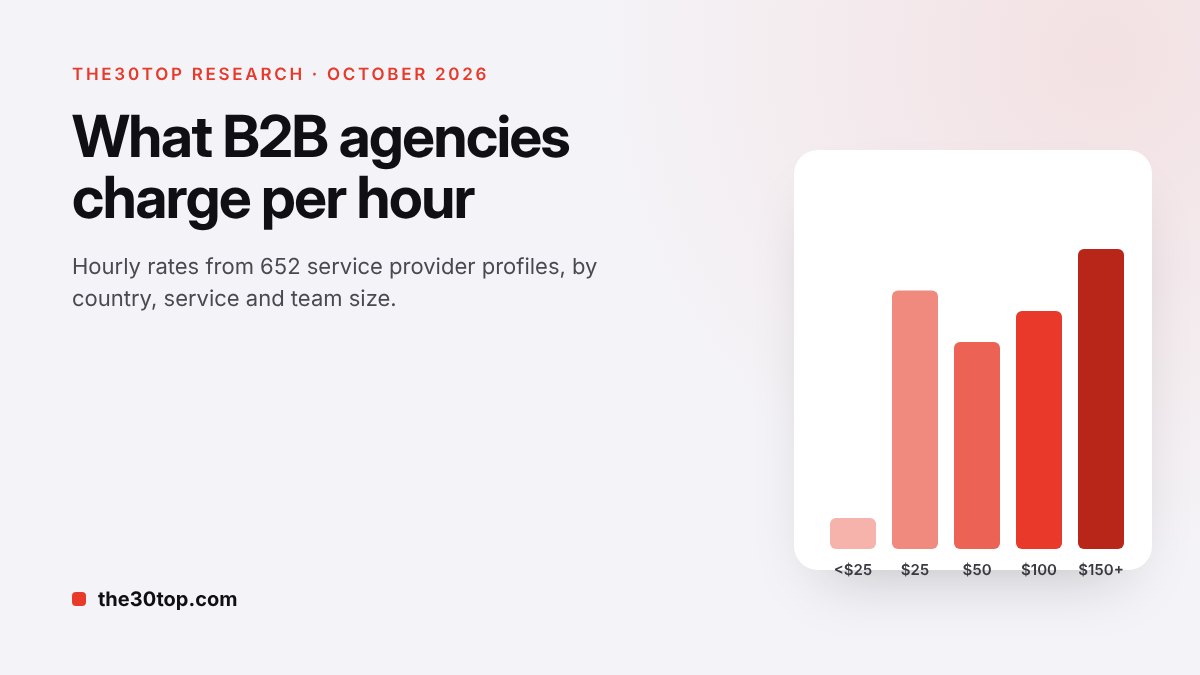
Agency Hourly Rates in 2026: What 652 B2B Service Providers Charge
We analyzed the hourly rates listed on 652 B2B service provider profiles on the30top. Here is what agencies charge by country, service and team size, and how to use hourly rates when you compare proposals.
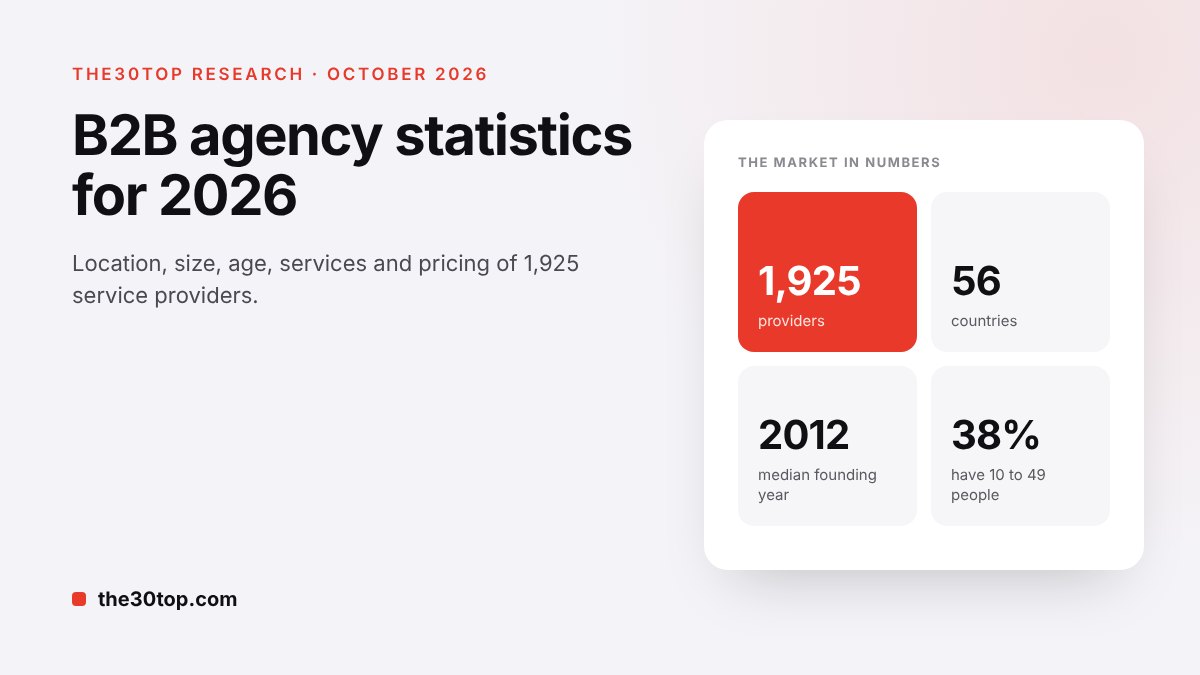
B2B Agency Statistics for 2026: Size, Age, Location and Services of 1,925 Providers
Statistics on the 1,925 B2B service providers listed on the30top: where they are based, how big and how old they are, what they do, which industries they serve and what they charge.
Explore the30top
Ready to shortlist a partner?
Move from research to a shortlist with companies ranked by our published score.