Popular Article
Agency Pricing Models Explained: Hourly, Fixed Fee, Retainer, Value-Based and Pay for Results
How each agency pricing model works, who carries the risk when work runs over, one project priced five different ways, and which model suits which kind of work.
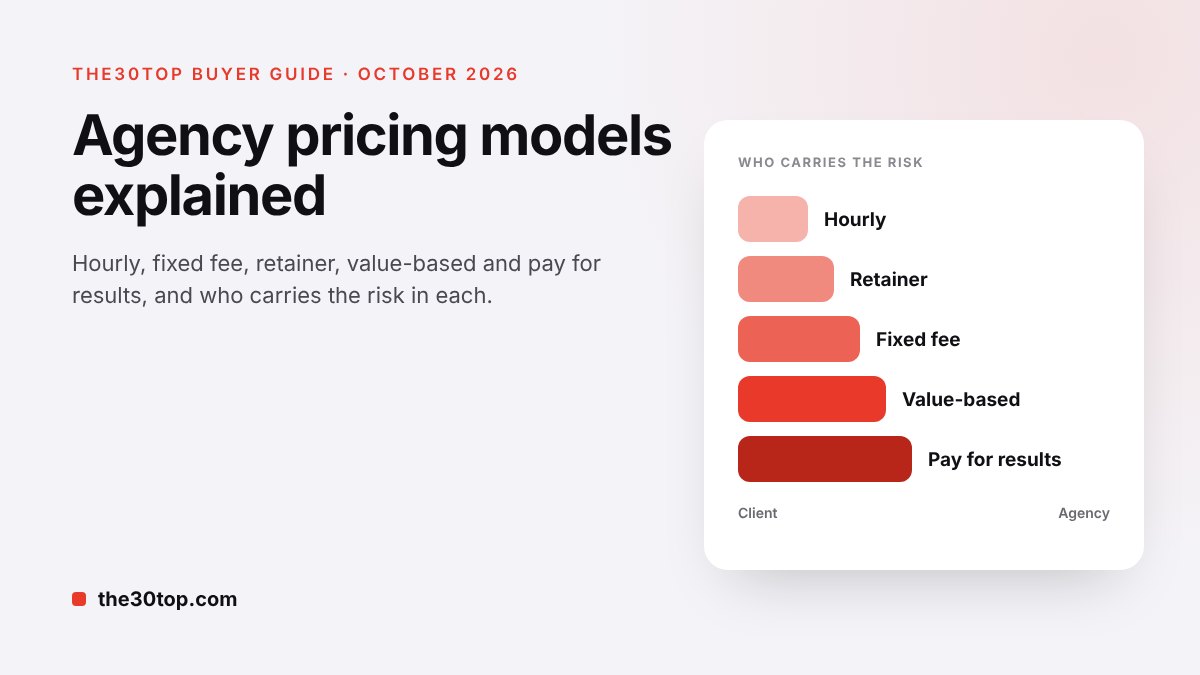
The five pricing models at a glance
Every agency proposal, however it is presented, rests on one of five ways of charging. Most disputes between clients and agencies start with a mismatch between the model and the work rather than with the price itself, so it pays to know what each one means before you compare quotes.
- Hourly
- You pay for the hours worked at an agreed rate, usually billed monthly against timesheets. Also called time and materials.
- Fixed project fee
- You pay an agreed price for a defined set of deliverables, however many hours they take.
- Monthly retainer
- You pay a fixed monthly fee for an agreed amount of ongoing work or team capacity.
- Value-based
- The price is set by what the outcome is worth to your business, not by the effort it takes.
- Pay for results
- Some or all of the fee depends on results such as leads, sales or rankings. Also called performance-based pricing.
Two variants turn up often enough to name. Percentage of ad spend is common in paid media, where the management fee is a share of your advertising budget. Hybrid pricing combines a fixed base fee with a bonus for hitting targets. Both are covered below.
Who carries the risk in each model
The simplest way to compare the models is to ask one question: who pays when the work takes longer than planned, or delivers less than hoped?
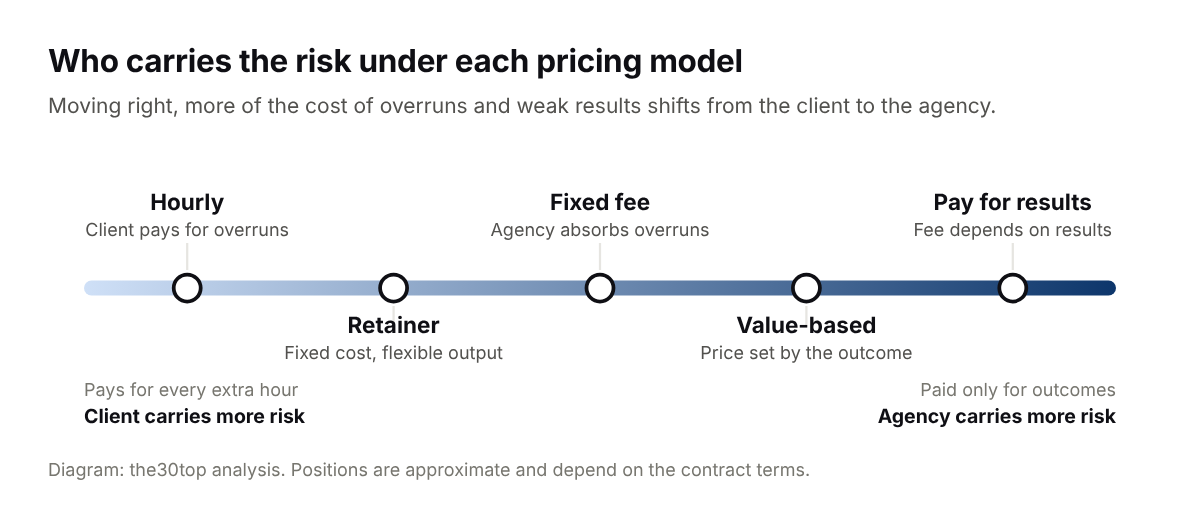
Under hourly billing you carry the risk of overruns; under a fixed fee the agency does. Retainers sit in between: the monthly cost is fixed, but what it buys depends on how the hours are used. Value-based and pay-for-results pricing move the most risk to the agency, which is why agencies charge more for them or accept them only when they control the levers that drive the result.
Neither end of the spectrum is better. Risk always has a price. An agency that takes on the risk of overruns adds a buffer to its quote, and a client who keeps the risk saves that buffer but has to manage scope closely.
What sits inside every quote
Whatever the model, almost every agency builds its price from the same parts. Knowing them lets you ask the right questions, because a quote that hides one of them is hard to compare with one that shows it.
| Part | What it covers | What to ask for |
|---|---|---|
| Estimated hours by role | Strategy, design, development, writing, project management | The hours for each role, not one total |
| Rates | An hourly or daily rate for each role, or one blended rate | The rate card, and how the blended rate was worked out |
| Project management | Meetings, planning, reporting and coordination | Whether it is included or billed on top, and how many hours it takes |
| Contingency | A buffer for unknowns, larger in fixed-fee quotes | How big it is, and what happens to it if it is not used |
| Third-party costs | Software, stock images, fonts, hosting, plugins, testing devices | A separate list, billed at cost or with a stated markup |
| Media spend | Advertising budgets paid to platforms | To keep it apart from the agency fee in every report |
A blended rate is the average of the agency's rates across the roles on your project. It makes a quote simpler to read, but it hides the mix: a project staffed mainly with juniors and a project staffed mainly with seniors can carry the same blended rate on paper. Ask for the hours by role as well.
Hourly billing
You agree a rate, or a rate card by role, and pay for the hours actually worked. On the30top, the median hourly rate listed by agencies on 24 October 2026 fell in the $100 to $149 band; our agency hourly rate data breaks it down by country, service and team size.
Hourly billing suits work that cannot be fully specified in advance: early product development, ongoing support, audits that may uncover more than expected. It is the most transparent model and the quickest to start, but it hands the job of controlling cost to you.
Choose it when
- The scope is likely to change as you learn more
- You want to pay only for work actually done
- You have time to review timesheets and priorities each month
Watch out for
- No natural ceiling on total cost
- Incentives that reward hours rather than efficiency
- Monthly invoices that are hard to forecast
Clause to ask for
A not-to-exceed cap per month or per phase, written approval before any work beyond it, and timesheets broken down by role and task.
Fixed project fee
The agency quotes one price for a defined scope: a website, a brand identity, an app release. It estimates the hours, adds a margin for risk and commits to the number. If the work takes longer, the agency absorbs the cost. If you change the scope, you pay for the change.
Fixed fees are the usual model for branding and design projects, where the deliverables can be listed in advance. Our branding cost research found that 79% of branding agencies on the30top set a minimum budget of $10,000 or more, which is typically the floor for a fixed-fee identity project.
Choose it when
- You need to know the total cost before you start
- The deliverables can be written down precisely
- You want the agency to carry the risk of overruns
Watch out for
- A risk buffer built into the price
- Every change turning into a change request
- Corners cut late in the project when the estimate was too low
Clause to ask for
A deliverables list with acceptance criteria, a set number of revision rounds, and prices for common changes agreed before the project starts.
Monthly retainer
A retainer is a fixed monthly fee for ongoing work: SEO, content, social media, paid media management, IT support. It buys either a defined output, such as eight articles a month, or a block of capacity, such as forty hours a month, usually with a minimum term.
Retainers dominate marketing services because the work is continuous and its results build over time. They also explain why marketing agencies list low minimums: in our minimum project size data, 17 of the 18 SEO providers listing a minimum on 24 October 2026 accepted engagements from $1,000, which usually means a first month of a retainer rather than a one-off project.
Choose it when
- The work is ongoing and its results build over time
- You want a predictable monthly cost
- You value a team that keeps context on your business
Watch out for
- Unused hours that do not roll over
- Output that drifts when nobody reviews it
- Long minimum terms that make it hard to leave
Clause to ask for
A monthly report of hours or deliverables against plan, a rollover rule for unused hours, and a notice period of 30 days after the initial term.
Value-based pricing
Value-based pricing sets the fee by what the outcome is worth to you. For example, a pricing page redesign expected to add $500,000 a year in revenue might be priced at $50,000, even if it takes only a few weeks. The agency is selling a result and the expertise behind it, not its time.
It is most common with senior specialists and strategy work, where a small amount of time changes a large number. It can be fair to both sides, but only if they agree how the value will be estimated before the price is set.
Choose it when
- The outcome is clear and can be measured
- Expertise matters far more than hours
- The agency is confident enough to stand behind the number
Watch out for
- Prices that feel high relative to the effort
- Value estimates that are easy to inflate
- Quotes that are hard to compare with other agencies
Clause to ask for
A written statement of the expected outcome and how it will be measured, so the price is tied to something both sides can check.
Pay for results
Under performance pricing, part or all of the fee depends on results: a price per qualified lead, a share of revenue, a bonus for reaching a target. It is most common in paid media, lead generation and affiliate marketing, where results can be traced to a campaign.
Pure pay-for-results deals are rare among established agencies, because results depend on things the agency does not control: your product, your prices, your sales team. Most performance deals are hybrids, with a reduced base fee and a bonus tied to agreed targets.
Choose it when
- Results can be measured and attributed cleanly
- The agency controls most of what drives the result
- You want to share risk and reward
Watch out for
- An agency chasing the metric rather than the business goal
- Arguments about attribution
- A higher total bill when results are good
Clause to ask for
A precise definition of each counted result, the tracking source both sides accept, and a cap on the total bonus.
How to structure a hybrid deal
Hybrid pricing, a fixed base fee plus a bonus for results, is often the fairest way to share risk. The base covers the agency's costs, so it does not have to gamble on things outside its control, and the bonus gives it a reason to push for the result you care about.
- 1Set the base fee at a level that covers the agreed work on its own. If the base is too low, the agency will cut effort in a slow month.
- 2Choose one or two measures the agency can actually influence, such as qualified leads from paid search, not company revenue as a whole.
- 3Agree a baseline from your own data before the work starts, so that improvement is measured from a known point.
- 4Pay the bonus in steps, for example a share at 80% of the target and the rest at 100%, rather than all or nothing.
- 5Cap the bonus, and review the targets every quarter so they stay realistic as the market changes.
When to start with a paid discovery phase
If you cannot yet define the work well enough for a fixed fee, and you do not want to commit to open-ended hourly billing, buy a short discovery phase first. It is a small fixed-fee project, often a few weeks long, in which the agency researches the problem, talks to your team and customers, and produces a scope, a plan and a firm quote for the main work.
Discovery costs money up front, but it usually saves more than it costs: the main quote carries less contingency because the unknowns have been explored, and you can take the scope to another agency if you prefer. Make sure the contract says you own the discovery outputs.
Good sign
An agency that suggests a paid discovery phase for a vague brief, instead of quoting a large fixed fee straight away, is usually being careful rather than difficult.
A note on percentage of ad spend
Many paid media agencies charge a percentage of your advertising budget as their management fee. It is simple, and the fee grows with the workload as budgets grow. The weakness is the incentive: the agency earns more when you spend more, whether or not the extra spend pays off.
If you use this model, set a floor and a ceiling on the fee and review spend against results every month. Once your budget is stable, ask whether the agency would move to a flat fee. Compare paid media agencies on the30top before you decide.
One project, priced five ways
To see how the models behave, take one project: a website redesign that the agency estimates at 300 hours, at a blended rate of $120 per hour. Then suppose the work runs 20% over, to 360 hours. The table shows what you would pay under each model in both cases.
| Pricing model | How it is priced | Runs to plan (300 hours) | Runs 20% over (360 hours) |
|---|---|---|---|
| Hourly | 300 hours at $120 | $36,000 | $43,200 |
| Fixed fee | Estimate plus a 15% risk margin | $41,400 | $41,400 |
| Retainer | $12,000 a month for three months | $36,000 | $36,000, with 60 hours of work still to do |
| Value-based | 10% of an expected $500,000 gain | $50,000 | $50,000 |
| Hybrid pay for results | $30,000 base plus $10,000 if targets are met | $30,000 to $40,000 | $30,000 to $40,000 |
Illustrative arithmetic, not market data. Real quotes vary with scope, seniority and location.
Three lessons stand out. The fixed fee costs more than hourly billing when the project runs to plan and less when it does not: you are buying insurance. The retainer looks cheapest, but it leaves work unfinished when the estimate was low. And with value-based and hybrid pricing the hours almost disappear from the conversation, because the price depends on the outcome.
How to compare quotes that use different models
Agencies on the same shortlist often quote in different ways, which makes the cheapest proposal hard to spot. The simplest fix is to turn every quote into an effective hourly rate: the total price divided by the hours the agency says the work will take.
| Quote | As presented | Estimated hours | Total price | Effective rate |
|---|---|---|---|---|
| Agency A | Fixed fee | 300 | $41,400 | $138 an hour |
| Agency B | $9,000 a month for four months | 280 (70 a month) | $36,000 | $129 an hour |
| Agency C | $115 an hour, capped at 340 hours | 320 | $36,800, up to $39,100 | $115 an hour |
Illustrative figures. The effective rate is the total price divided by the agency's own estimate of hours.
The effective rate is a starting point, not the answer. Agency A costs the most per hour but carries the risk of overruns. Agency B quotes the fewest hours, so ask what it has left out. Agency C is cheapest per hour, but you pay for any extra hours up to the cap. The right choice depends on how confident you are in the scope, which is exactly the question the pricing model answers.
Which model fits which service
| Service | Usual model | Why |
|---|---|---|
| SEO and content marketing | Monthly retainer | Results build over months and the work never really ends. |
| Paid search and paid social | Retainer or percentage of ad spend, sometimes with a bonus | Spend and results are tracked closely, so performance terms are practical. |
| Branding and identity | Fixed fee per phase | Deliverables can be defined, and strategy needs a clear end point. |
| Website design and build | Fixed fee, with hourly billing for changes | Scope can be specified; changes are priced separately. |
| Custom software and apps | Hourly or monthly sprints, sometimes fixed-price phases | Requirements change as the product takes shape. |
| Managed IT services | Monthly fee per user or device | Support is continuous and scales with your headcount. |
How to choose the right model for your project
- 1Write down how well you can define the work today. If you can list every deliverable, ask for a fixed fee. If you cannot, start with hourly billing or a short paid discovery phase.
- 2Decide who should carry the risk of overruns, and accept that whoever carries it will price it in.
- 3Match the commitment to the work: projects for things that end, retainers for things that continue.
- 4Ask every shortlisted agency to quote in the same model, so you can compare like with like.
- 5Whatever the model, ask for the assumed hours by role. It is the only way to see what you are actually buying.
Pricing red flags in a proposal
- A single total with no hours, roles or deliverables behind it.
- A fixed fee far below every other quote, which usually means the scope was read differently or the agency plans to recover the gap through change requests.
- Retainers with no statement of what the monthly fee buys.
- Performance deals where the agency defines and tracks the results itself, with no access for you.
- Media spend and agency fees mixed together on one invoice.
- Long minimum terms with no break clause after a trial period.
Terms to settle before you sign, whatever the model
- Payment schedule and invoice dates
- What happens to unused hours or budget
- How changes to scope are requested, priced and approved
- Who owns the work, including source files, accounts and data
- The notice period, and what the agency hands over when you leave
- What reporting you receive, how often and from whom
- Who your day-to-day contact is, and who replaces them if they leave
Frequently asked questions
What is the most common agency pricing model?
It depends on the work. For ongoing marketing such as SEO, content and social media, the monthly retainer is most common. For defined projects such as a brand identity or a website, the fixed fee is the norm. Hourly billing is common for development and consulting, where the scope changes as the work goes on.
Is a retainer better than paying by the hour?
A retainer is better when the work is continuous and you want predictable costs. Hourly billing is better when the amount of work varies a lot from month to month. Either way, ask for a monthly breakdown of hours or deliverables.
What is value-based pricing?
A price set by the value of the outcome to your business rather than the hours involved. It works when the outcome can be measured and both sides agree how value is estimated before the price is set.
Do agencies work on a pay-for-results basis?
Some do, mostly in paid media and lead generation. Pure pay-for-results deals are rare because results depend on factors the agency does not control, so most performance deals combine a lower base fee with a bonus.
Why is a fixed-fee quote higher than an hourly estimate?
Because the agency takes on the risk of overruns and prices that risk in. If the project runs to plan, a fixed fee costs more; if it runs over, it costs less. You are paying for certainty.
How do agencies charge for managing paid advertising?
Usually a percentage of ad spend, a flat monthly fee, or a hybrid with a performance bonus. Ask for a floor and a ceiling on percentage fees, and keep the advertising budget separate from the agency fee in your reporting.
What is a blended hourly rate?
The average of an agency's rates across the roles on your project, weighted by hours. It makes a quote simpler, but it hides the mix of senior and junior time, so ask for the hours by role as well.
Is a paid discovery phase worth it?
Usually, when the scope is unclear. A short fixed-fee discovery phase produces a scope and a firm quote for the main work, reduces the contingency built into that quote, and gives you a plan you own even if you choose a different agency.
Can I combine pricing models?
Yes, and it is common. A fixed-fee discovery phase followed by a monthly retainer, or a fixed-fee website build with hourly billing for later changes, often gives the best balance of certainty and flexibility.
About the author
The 30Top Research Team (Research & analysis). We research service categories, interview buyers and maintain the30top rankings. Resource content is independent of listings and never paid for.
Related reading
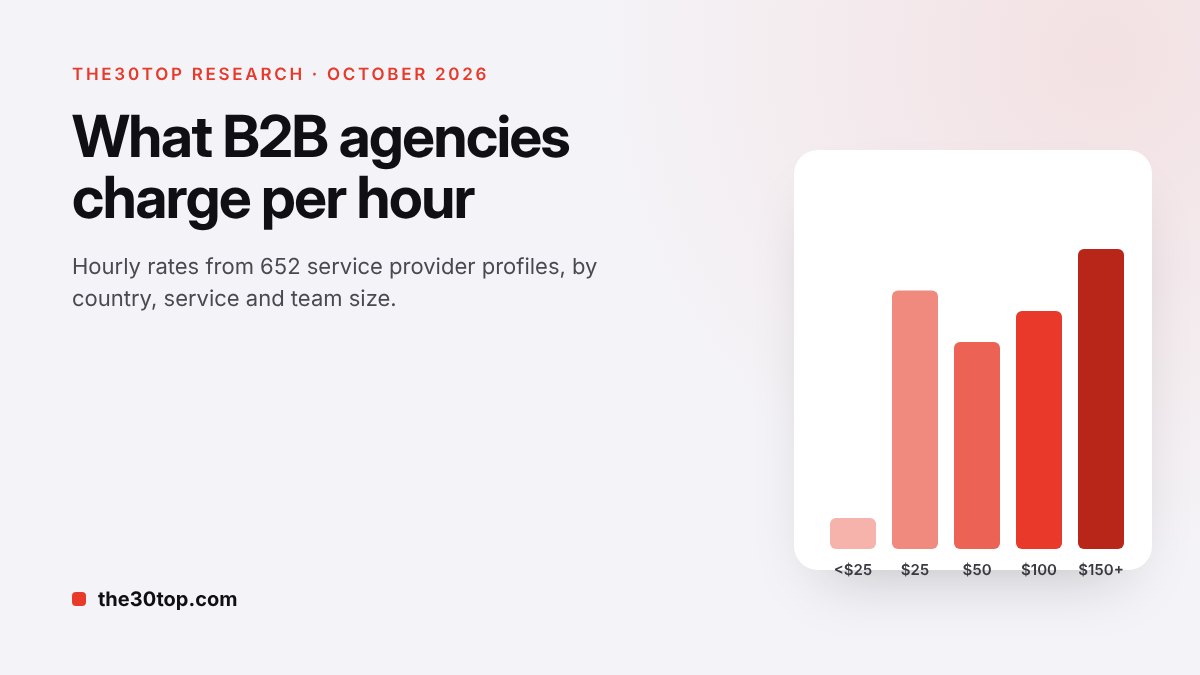
Agency Hourly Rates in 2026: What 652 B2B Service Providers Charge
We analyzed the hourly rates listed on 652 B2B service provider profiles on the30top. Here is what agencies charge by country, service and team size, and how to use hourly rates when you compare proposals.
Agency Minimum Project Size: How Much Budget You Need to Hire an Agency in 2026
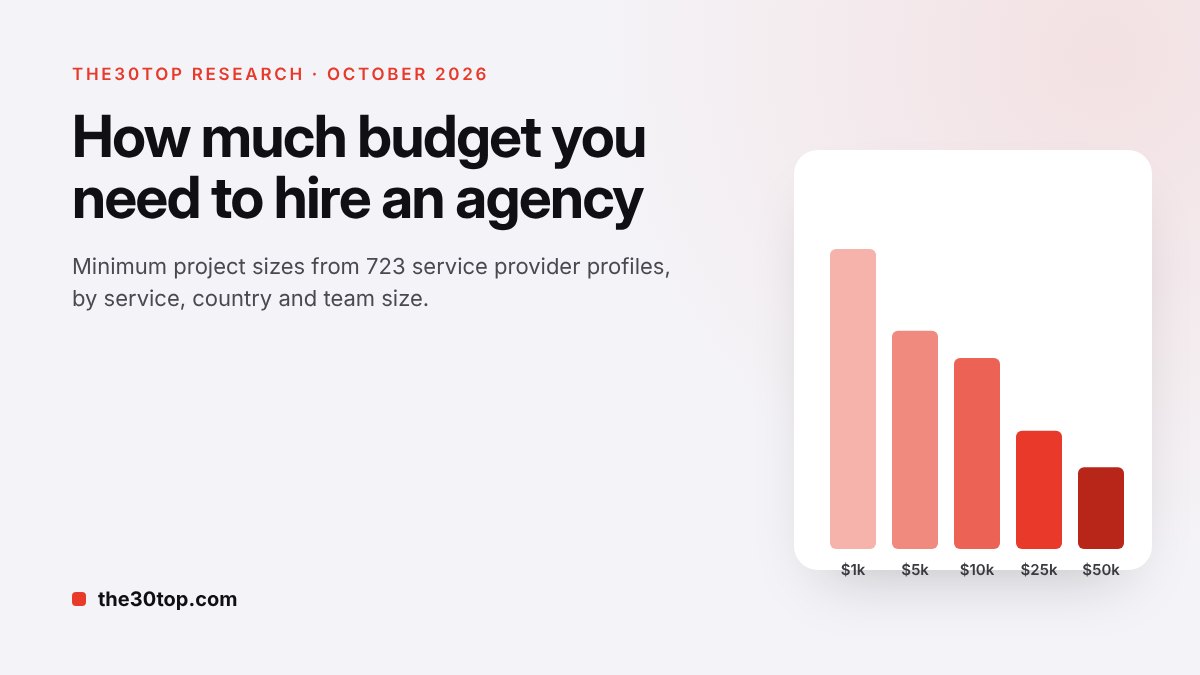
Most agencies set a minimum project size. We analyzed 723 provider profiles on the30top to show typical minimums by service, country and team size, and what you can get at each budget level.
How Much Does Branding Cost in 2026? Rates and Budgets From 79 Branding Agencies
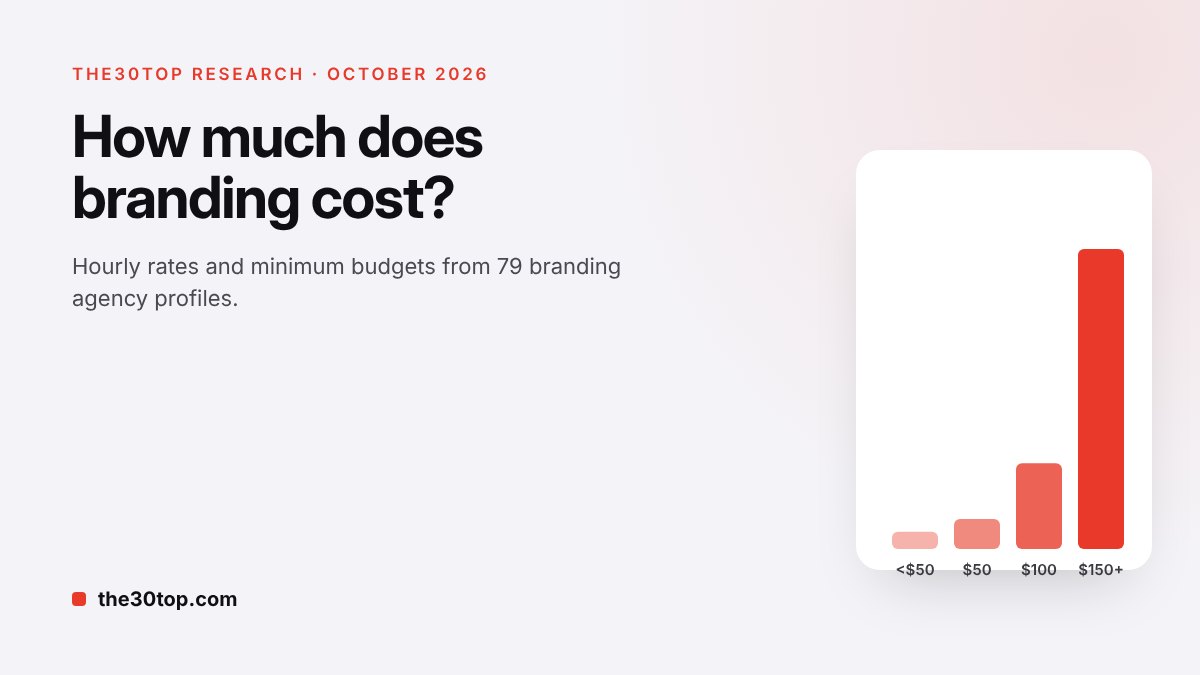
What branding agencies charge in 2026, based on the hourly rates and minimum budgets listed by 79 branding agencies on the30top, plus what a branding project includes and how to budget for yours.
Explore the30top
Ready to shortlist a partner?
Move from research to a shortlist with companies ranked by our published score.