Popular Article
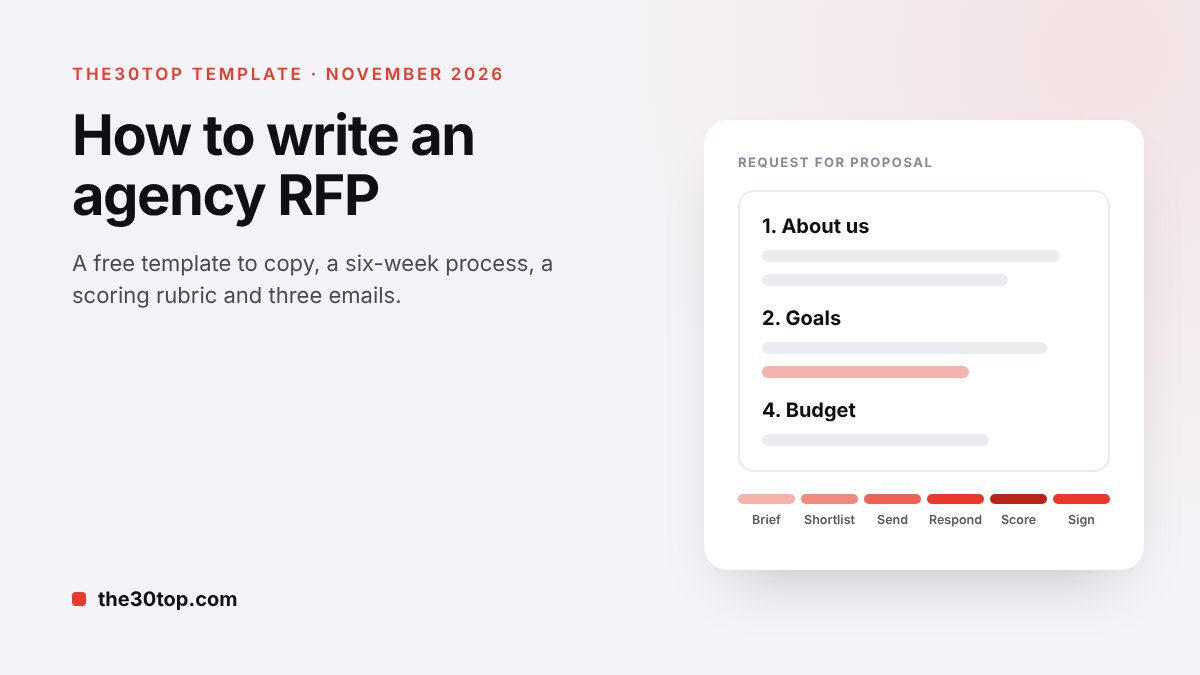
How to Write an Agency RFP: A Free Template and Six-Week Process
A free request for proposal template you can copy section by section, a six-week timeline from brief to signed contract, a scoring rubric, and the mistakes that put good agencies off.
When you need an RFP, and when you do not
A request for proposal, or RFP, is a written brief you send to a shortlist of agencies so they can propose how they would do the work and what it would cost. Done well, it gets you proposals you can compare. Done badly, it costs everyone weeks and puts off the agencies you most want.
Use an RFP when
- Several people will make the decision and need a shared basis for it
- The budget is large enough that a wrong choice is expensive
- Your organisation's procurement rules require one
- You want proposals in a comparable format
Skip it when
- The project is small enough to agree in a call and a short proposal
- You already know which two agencies you want to speak to
- You need to start within two weeks
- You cannot yet describe the goal; buy a short paid discovery phase instead
RFI, RFP or RFQ: which one you need
The three documents are often confused, and sending the wrong one is a common reason for disappointing responses.
- RFI: request for information
- A short questionnaire sent to a long list to learn who could do the work: services, team size, relevant clients, rough pricing. Use it when you do not yet know the market well enough to build a shortlist.
- RFP: request for proposal
- A brief sent to a shortlist asking how each agency would reach your goal and what it would cost. Use it when the goal is clear but the best way to reach it is not.
- RFQ: request for quotation
- A request for prices on a scope you have already defined in detail. Use it when you know exactly what you need and are mainly comparing cost and timing.
Most agency selections need only an RFP. If you have no shortlist yet, you can often skip a formal RFI by comparing agency profiles, minimum budgets and past work in a directory before you invite anyone.
A six-week timeline from brief to signed contract
- 1
Week 1
Write the brief and agree the budget range
Agree the goal, the budget range, who decides and how. Name one owner for the process and one contact for agencies.
- 2
Weeks 1 to 2
Build a longlist, then a shortlist
Start with eight to ten agencies from rankings, referrals and past work you admire, then cut to three to five. Check each agency's minimum project size against your budget before you invite it.
- 3
Week 2
Send the RFP and answer questions
Send the same document to every agency with a deadline for questions. Answer every question in writing and share the answers with all of them.
- 4
Weeks 3 to 4
Give agencies two weeks to respond
Two weeks is a fair minimum for a considered proposal. Less tends to produce recycled proposals from agencies with spare capacity.
- 5
Week 5
Score proposals and meet the top two or three
Score each proposal against your rubric before you discuss it as a group, then invite the strongest to present to the people who will decide.
- 6
Week 6
Check references, agree terms and sign
Speak to two clients of your preferred agency, agree the pricing model and contract terms, and tell the other agencies your decision.
The RFP template
Copy each block into your own document and replace the text in square brackets. Keep the whole RFP to four to six pages: agencies give their best thinking to briefs they can read in one sitting.
1. About us
[Company name] is a [type of business] serving [customers] in [markets]. We have [number] employees and [annual revenue range, optional].
Our main products or services are [list]. Our main competitors are [list].
This project is owned by [name, role]. The final decision will be made by [names or roles].
2. Goals and how we will measure success
We want to [business goal, for example: increase qualified demo requests from organic search].
Today we [current state, with numbers where possible]. In [timeframe], we want to reach [target].
We will judge success by [measures], reported [monthly or quarterly].
3. Scope of work
We are looking for help with: [list of services or deliverables].
Out of scope: [work handled in-house or by other partners].
Existing assets you will work with: [website platform, brand guidelines, analytics, previous research].
4. Budget and pricing format
Our budget for this work is [range] for [one-off project or per month].
Please price your proposal as [fixed fee by phase / monthly retainer / hourly with an estimate], and show the estimated hours by role.
Please also tell us what you would remove to fit the bottom of our range, and what you would add at the top.
5. Timeline
Questions by: [date]. Proposals due: [date]. Presentations: [dates]. Decision by: [date]. Work starts: [date].
Key dates the work must meet: [launches, events, seasonal peaks].
6. Requirements and constraints
Technical: [platforms, integrations, security or hosting requirements].
Legal and compliance: [industry rules, data protection, accessibility standards].
Ways of working: [time zones, languages, meeting cadence, tools].
7. Questions for agencies
1. How would you approach our goal, and what would you do in the first 90 days?
2. Who would work on our account? Please include roles, seniority and other client commitments.
3. Show two pieces of work similar to this project and the results they achieved.
4. How will you report progress, and which numbers will you report?
5. What do you need from us to succeed?
6. What are your contract terms, minimum term and notice period?
8. How we will evaluate proposals
We will score proposals on: understanding of our goals (20%), relevant experience and evidence (20%), approach and plan (20%), the team doing the work (15%), price and value (15%), and fit and communication (10%).
We will not ask for unpaid creative or strategy work as part of this process.
9. How to respond
Send your proposal as a single PDF of no more than [number] pages to [name, email] by [date and time zone].
Send questions to the same address by [date]. We will share all answers with every agency taking part.
We will tell every agency the outcome by [date].
If you are unsure which pricing format to ask for in block 4, our explainer on agency pricing models compares hourly, fixed-fee, retainer, value-based and pay-for-results pricing.
A filled-in example
Templates are easier to use when you can see one completed. Here are the three blocks people find hardest, filled in for a fictional company. Notice how specific the numbers are: that is what lets agencies propose something real.
Example: about us
We are a bookkeeping software company serving small accounting firms in the United States and Canada. We have 45 employees.
Our main product is a cloud bookkeeping platform sold on a monthly subscription. Our main competitors are two larger accounting software brands and several regional providers.
This project is owned by our Head of Marketing. The final decision will be made by the Head of Marketing and the Chief Executive.
Example: goals and how we will measure success
We want to increase qualified demo requests from organic search.
Today organic search brings about 40 demo requests a month, of which about 15 become qualified opportunities. In 12 months, we want 30 qualified opportunities a month from organic search.
We will judge success by qualified opportunities from organic search, as recorded in our CRM, reported monthly.
Example: budget and pricing format
Our budget for this work is $6,000 to $9,000 a month for an initial 12 months.
Please price your proposal as a monthly retainer, and show the estimated hours by role each month.
Please also tell us what you would remove to fit $6,000 a month, and what you would add at $9,000.
Three emails you will need
The RFP document gets most of the attention, but the emails around it shape how agencies see you. These three cover the invitation, the shared answers to questions and the decision.
Invitation to respond
Subject: Request for proposal: [project name]
Hello [name], we are choosing an agency to help us [goal in one line], and based on your work for [client or project you admire], we would like to invite you to respond.
The RFP is attached. We are inviting [number] agencies. Questions are due by [date], and proposals by [date]. Our budget range is [range], and we will not ask for unpaid creative work.
Could you confirm by [date] whether you plan to respond? Thank you, [name, role].
Answers to agency questions
Subject: [project name] RFP: answers to questions
Hello all, thank you for your questions. Below are the answers we are sharing with every agency taking part, without naming who asked.
[Question 1] [Answer]. [Question 2] [Answer].
The deadline for proposals remains [date and time zone].
Telling an agency it was not chosen
Subject: [project name]: our decision
Hello [name], thank you for the time you put into your proposal. We have decided to work with another agency on this project.
What stood out in your proposal was [one specific strength]. What made the difference for the agency we chose was [one specific reason].
We would be glad to keep in touch for future work. Best regards, [name].
How to score proposals
Score each criterion from 1 to 5, multiply by its weight and add the results. The maximum is 5.0. Ask everyone on the panel to score on their own before you compare notes, so the loudest voice does not set the result.
| Criterion | Weight | What a strong proposal shows |
|---|---|---|
| Understanding of our goals | 20% | Restates the problem in its own words and challenges an assumption |
| Relevant experience and evidence | 20% | Similar work with results you can check, ideally with references |
| Approach and plan | 20% | A first 90 days with clear priorities, not a list of every service |
| The team doing the work | 15% | Named people, the right seniority and realistic capacity |
| Price and value | 15% | Hours by role, clear assumptions and options at both ends of your range |
| Fit and communication | 10% | Clear writing, good questions and a working style that suits yours |
Price carries 15%, not 50%. A cheap proposal from an agency that misunderstood the goal costs more in the end than a fair one from an agency that understood it.
How to run the presentations
Invite the two or three strongest agencies to present, and give each the same time slot and the same agenda. Ninety minutes is usually enough.
- 1Ten minutes: you restate the goal and anything that has changed since the RFP went out.
- 2Thirty minutes: the agency presents its approach and the first 90 days. Ask for the people who would work on your account to present, not only the founders or sales team.
- 3Thirty minutes: your questions, starting with the weakest points you noted when scoring the written proposal.
- 4Ten minutes: the agency's questions for you. Good agencies use this time well.
- 5Ten minutes: next steps, references and the decision date.
Score the presentation against the same rubric straight afterwards, before the panel discusses it. If you are hiring for SEO, our 15 questions to ask an SEO agency work well as the question section.
Check before you send
- The goal is stated in one sentence with a measure of success
- A budget range is included, with the pricing format you want
- Every agency on the shortlist accepts projects at your budget
- Dates for questions, proposals, presentations and decision are set
- The scoring criteria and weights are written into the RFP
- One named contact will answer every agency's questions
- The document is no longer than six pages
- You are not asking for unpaid creative or strategy work
Mistakes that put good agencies off
- No budget. Agencies either guess or decline, and the proposals you receive cannot be compared.
- Inviting ten or more agencies. Good agencies weigh their odds and skip long lists.
- Asking for free creative work. Speculative work rewards the agency with the most spare time, not the best thinking, and many strong agencies refuse it.
- Unrealistic deadlines. A proposal turned around in three days is usually a template.
- Dozens of questions. A long questionnaire produces long, generic answers. Six focused questions produce better ones.
- No decision date, or a decision that slips by months. Agencies hold teams for the projects they win.
After you choose
Tell the agencies you did not choose, and give each a few lines of honest feedback. It costs little, and they will remember it the next time you need them.
With the chosen agency, agree a kickoff agenda, the first 90 days of work and a review date at the end of that period. Our guide to evaluating a B2B agency covers what to check in the first months, and our comparison of in-house teams, agencies and freelancers can help if the RFP showed that part of the work belongs in-house.
Frequently asked questions
What is an agency RFP?
A request for proposal: a written brief sent to a shortlist of agencies, describing your goals, scope, budget and timeline, so each can propose how it would do the work and what it would cost.
Should I include my budget in an RFP?
Yes, as a range. Without it, agencies guess and the proposals cannot be compared. Budgets also decide who can take part: on 24 October 2026, 57% of providers on the30top that listed a minimum accepted projects under $10,000, while 22% required $25,000 or more.
How many agencies should I send an RFP to?
Three to five, chosen from a longer list. More than that discourages strong agencies and leaves you too many proposals to assess properly.
How long should agencies have to respond?
At least two weeks for a considered proposal, plus a few days at the start for questions.
Should I ask agencies for free creative work?
No. Ask for their approach, relevant examples and the team instead. If you want to see thinking applied to your problem, pay for a short discovery phase.
How long should an agency RFP be?
Four to six pages is enough for most projects. Agencies give their best thinking to a brief they can read in one sitting, and a long document tends to produce long, generic answers.
Should I share the RFP answers with every agency?
Yes. Answer questions in writing and send the same answers to every agency taking part, without saying who asked. It keeps the process fair and the proposals comparable.
What is the difference between an RFP, an RFI and an RFQ?
An RFI (request for information) gathers basic facts to build a shortlist. An RFP asks shortlisted agencies how they would do the work and at what cost. An RFQ (request for quotation) asks only for prices on a scope you have already defined.
About the author
the30top Research Team (Research & analysis). We research service categories, interview buyers and maintain the30top rankings. Resource content is independent of listings and never paid for.
Related reading
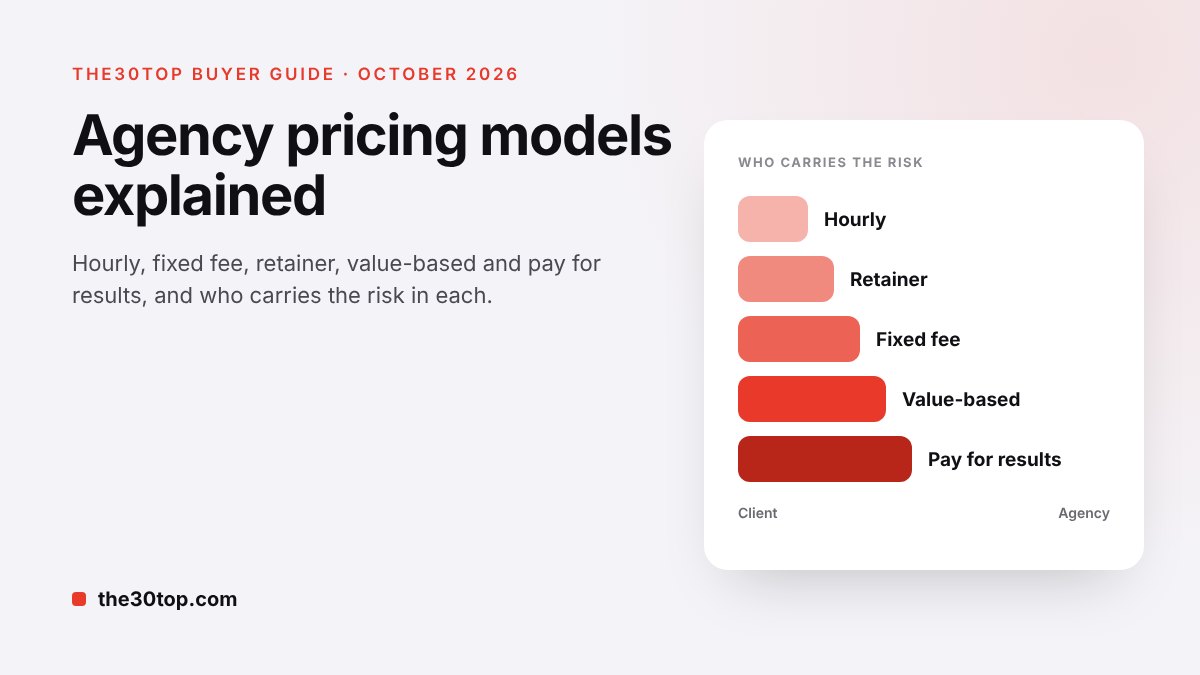
Agency Pricing Models Explained: Hourly, Fixed Fee, Retainer, Value-Based and Pay for Results
How each agency pricing model works, who carries the risk when work runs over, one project priced five different ways, and which model suits which kind of work.
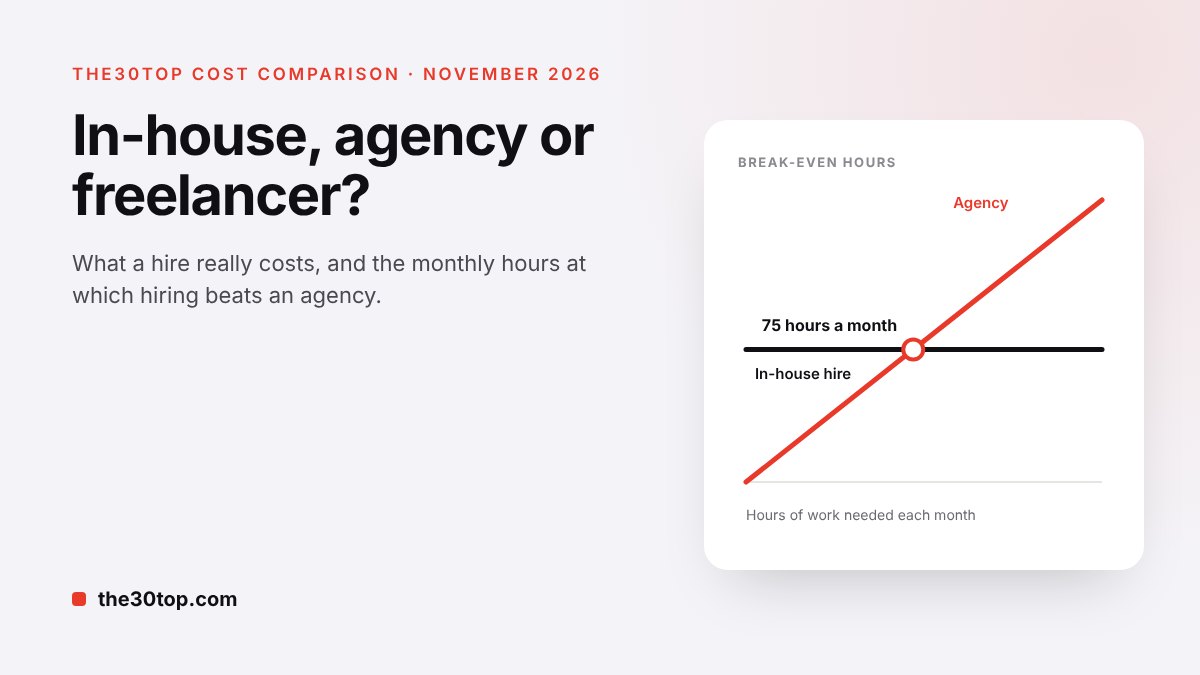
In-House Team, Agency or Freelancer? A 2026 Cost Comparison With Break-Even Hours
What an in-house hire really costs once benefits are included, how many hours of agency work that buys, and when an agency, an employee or a freelancer is the better choice.
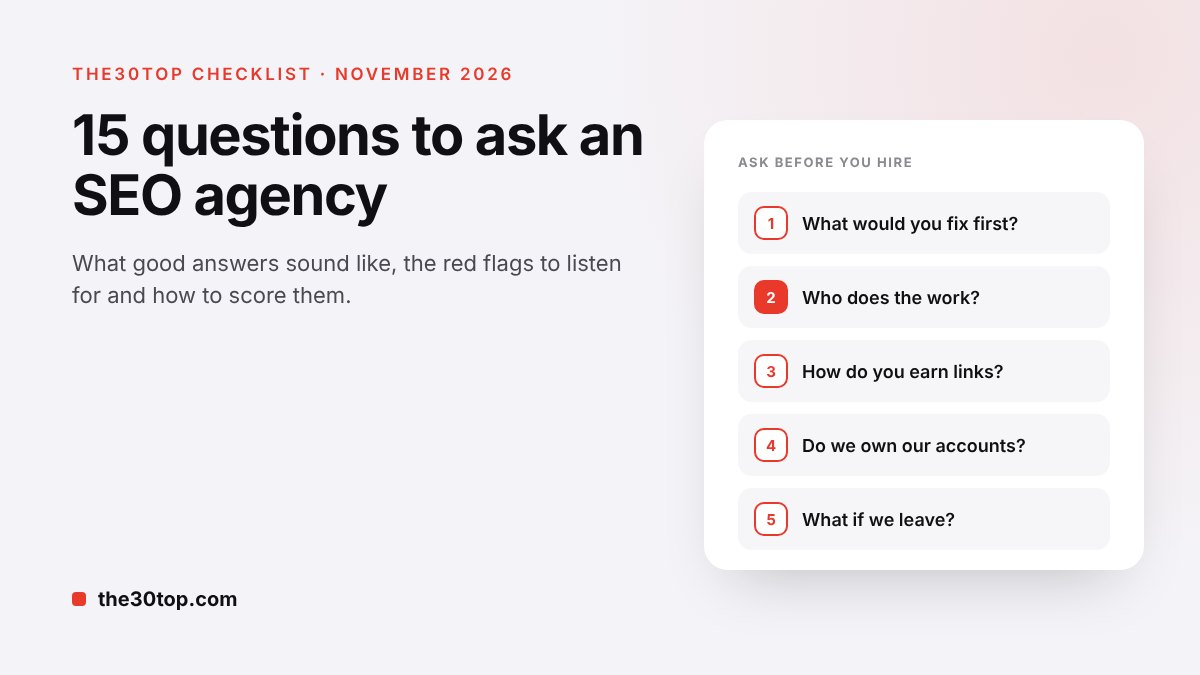
15 Questions to Ask an SEO Agency Before You Hire, and What Good Answers Sound Like
The questions that separate a capable SEO agency from a polished pitch, with what a good answer sounds like, the red flags to listen for, and a simple way to score each agency.
Explore the30top
Ready to shortlist a partner?
Move from research to a shortlist with companies ranked by our published score.